Thursday, February 01, 2007

UMA turns up the heat on VoIP services

It in a little covered but very insightful announcement, Orange in France announced “Unik Professional”, a version of it’s popular, consumer oriented UMA-based unik service. The professional version is targeted at small businesses.


The amazing thing about it is that for a flat €15/month, subscribers get UNLIMITED calls to ANY fixed lines in France, Europe and North America when connected over the unik/IP/UMA network. Unbelievable!

Now with your standard mobile phone (and phone number), unik subscribers can make unlimited fixed line calls over the unik network.

Certainly here in the US there have been some interesting announcements lately. A couple months back Skype announced unlimited Skype out to fixed lines in the US for $15 for an entire year. But it is “out”, so it’s not part of the regular calling pattern for most people.


Then AT&T announced Unity, offering unlimited calling between AT&T home & office fixed lines as well as mobile lines within the US.


But Orange’s offer, breaking outside the country and even outside it’s own continent is a HUGE step in driving fixed mobile substitution and making unik a compelling service offer.

Tuesday, January 16, 2007

Works better, costs less

In a recent survey of mobile phone users conducted in the US by comScore, the most popular reason to switch mobile service provider was to improve coverage, followed by switching to get lower prices.

UMA addresses both these issues, no wonder it’s become so popular.

Interesting, the press release about the survey pointed out that there was one exception, T-Mobile subscribers.

The majority of subscribers switching to T-Mobile did so for lower prices.

No wonder T-Mobile US is so interested in UMA, lower prices mean a tighter profit squeeze between revenues and operating expenses. By growing minutes of use in the home/office over the public internet (through UMA), they can lower opex and make these new, discounted calling packages more profitable.

Friday, January 05, 2007

Why Fusion Hasn't Fused

A comment I hear a lot in the analyst community is “the way of BT Fusion, so goes the fortunes of all UMA service offers”. BT has been the yardstick by which many in the industry measure the success of UMA.

It’s true that BT pioneered UMA and mobile/Wi-Fi convergence. But understanding why Fusion didn’t fuse fixed and mobile services together for BT offers some important lessons for other fixed operators getting into the market.

As one of the few incumbent fixed operators without a mobile play, BT needed to do something to stem the loss of revenues vis a vis fixed VoIP providers as well as the inevitable migration to mobile services.

Launching a full year before subsequent UMA offers, Fusion did set the stage for dual mode services. But the nagging question remains: if FMC is so hot, why does BT have just 30,000 – 50,000 subscribers?

Fusion is Mobile, BT is Fixed

A fixed operator trying to sell mobile services...just the phrase makes one shake their head. Yet this was the challenge BT was presented with when rolling out Fusion. While well known (perhaps even “infamous”) in the UK, BT does not present itself as a leader in mobile communication services. The UK mobile market is fiercely competitive with O2, T-Mobile, Orange and Vodafone each splitting roughly 20% of the market. Enter BT with Fusion and there is a lot of work to be done to win over skeptical consumers that BT is a player in the mobile world.

What about a channel?

Then there is the trouble of retail outlets. Consumers like to go to mobile phone stores to check out the handsets. But BT, as a fixed service provider and not in the consumer electronics distribution business, was lacking any retail presense. With limited handsets in the Fusion offer and limited retail presence, the service also had to convince subscribers to take on a new device with no first hand experience.

Mobile/Wi-Fi convergence is about FMS, not MFS

Fundamentally mobile/Wi-Fi convergence is deployed to accelerate fixed-to-mobile substitution (FMS). Yet BT was using UMA as the exact opposite, to retain minutes of use on the fixed network.

This was borne out in the pricing packages. The pricing was designed to preserve fixed line rates rather than undercut them to drive traffic onto the mobile network. Calls to fixed line numbers on Fusion are billed at the same rate as calls made from land lines. Thus there is no incentive to move traffic from the fixed network.

This point was made clear in the slide below from Peter Erskin, CEO of O2/Telephonica, who presented the content below in Nov, 2005.

The slide shows BT Fusion under the heading "fixed operators are trying to win minutes back from mobile operators". That says it all.

Where’s UMA?

The point of all this is Fusion faced a lot of challenges coming to market. But none of these burdens were based on UMA as a technology. BT’s challenges were based on business, market and channel realities.

How does this bode for other fixed operators in the mobile/Wi-Fi convergence market? Two notable services are up and running today. First is Deutsche Telecom’s T-One service http://www.t-one.de/flash/index.php . The other is Embarq’s (http://www.unstrung.com/document.asp?doc_id=109055) Smart Connect service. Not much has been published on the success of these services to date, so it’s hard to tell if they are suffering the same fate as Fusion.

However, like Fusion, both are offered by the fixed operator and focus on extending fixed line voice services to the mobile network. And like BT, both are hampered not so much with technology issues, but market, business and channel realities.

Tuesday, January 02, 2007

FMC is the prediction for 2007

As we get back to things after a (very) short holiday break, it’s fun to see the predictions for 2007. It seems like everywhere we turn, there’s another prediction about FMC and dual mode services.

Not all embrace UMA as the technology to drive all this convergence, which makes sense, UMA is for mobile (and integrated) operators. There will be plenty of fixed operators trying to keep in-home voice minutes on the fixed network, and to do that, they will need to launch pre-standard SIP-type services. But for mainstream operators, UMA is the technology which will deliver fixed mobile substitution as well as a way to combat all those operators with competitive offerings.


http://www.lightreading.com/document.asp?doc_id=113522


http://www.pcw.co.uk/vnunet/analysis/2171424/fixed-mobile-convergence-big


http://disruptivewireless.blogspot.com/2006/12/dual-mode-fmc-services-2006-final-score.html


http://www.fiercewireless.com/story/fmc-will-find-a-home/2007-01-02


http://www.lightreading.com/document.asp?doc_id=113442&WT.svl=news1_6


http://mobileenterprise.typepad.com/


http://www.networkworld.com/news/2006/120706-2007-it-predictions-for-the.html?page=3

Wednesday, December 20, 2006

Predictions for UMA 2007

Well, it’s that time of the year, when we take stock of where we have come from and evaluate where we are going. 2006 was very good for UMA technology, four launches by well known operators. But what’s the prognosis for 2007? More of the same?

Handsets models available will more than double

This is an easy one. Today Samsung, Nokia and Motorola each have a UMA device available. But Nokia has already announced a second unit and it’s easy to see new models coming from Samsung and Motorola. Then rumors abound about RIM and Sagem jumping into the market. But the UMAer has some inside information about some early players in the UMA handset market coming back strong in 2007 with new units. Double? Perhaps we should say triple the units in 2007.

Subscriber counts will go through the roof...

Well, that depends on how high the roof is, but if the UMA roof is 1m subscribers in 2007, then rest assured that we’ll see far more than that. Orange quietly predicted 1m subscribers in 2007 in France alone. That’s just under 5% of their total mobile base in France. If France, UK and Spain all get 5% subscriber penetration in 2007, Orange alone will have about 2m subscribers on UMA. T-Mobile in the US, with 25m subscribers, will likely do a similar number depending on how early in the year the service launches. But I happen to believe T-Mobile will have 1m UMA subscribers on net in 2007.

The others: Telecom Italia needs to resolve political issues before any significant traction will start, but indications are that the dust is settling. Telia, with all their excellent work, only has 1.5m mobile subscribers in Denmark. Saunalahti, committed to announcing their service in 2006. But let’s not forget the granddaddy of UMA offer, BT Fusion, which recently added Wi-Fi to the service offer. Subscriber counts are rumored to be anywhere from 30,000 to (a now discredited) 100,000. Unfortunately, at this point it’s clear Fusion isn’t going to be the 1m subscriber service they hoped for.

More operators launch service

UMA service is available in FR, UK, IT, ES, PL, NL, DK and FI. Not bad, but that’s with four service providers. The trend I believe will happen in 2007 is that a second operator in those countries will jump in with a UMA service to responds with a competitive threat. We should see at least four new operator/country launches in 2007.

VCC will actually be understood by the market

2006 was a year of VCC hype. VCC is the great white hope of fixed line operators everywhere to reign in FMS and put mobile calling back on the fixed network. Few of those discussing the “benefits” of VCC actually understand what it can, and far more importantly, what it can NOT do. My prediction is that in 2007 the market will actually understand what VCC can and can’t do.

Soon the market will uncover VCC. The “success” of T-One and other fixed line dual mode services will come to light and it will serve to highlight that UMA is the long term strategy for converging mobile and WiFi technologies.


So, are these really “predictions”? The UMAer has a lot of inside information. Perhaps this is just foreshadowing.

Thursday, December 14, 2006

DMH = FMC


Well, now that there is a study, it’s true. When asked what constitutes fixed-mobile convergence service, 75% of the respondents in a recent study proposed by FMC vendor Outsmart said dual mode handsets (DMH).

But FMC can mean many things, others mentioned in the survey include single billing (34%), a home zone rate plan (27%), voice mail convergence (13%) or a “Skype-like” solution (9%).

I think the funniest one in the list is the homezone rate plan, which presumably is the concept of giving consumers lower cost mobile calling when they are in a certain cell zone in their homes. This is, of course, a completely cellular solution with no reliance on the fixed network, ironic in an FMC survey.

We here at UMAToday have discussed the differences of FMC and FMS in the past. The conclusion was that UMA fits into either camp. So if DMH = UMA, and DMH = FMC, then UMA must equal FMC.

Given that FMC is being viewed as the business case driver for IMS, and now we know that DMH = FMC, it’s no wonder why there is so much pressure to get the pending VCC specification completed. VCC is the specification to make DMH work which equals FMC which is the business case driver for IMS.

The math is getting pretty complicated.

For some reason, I thought FMC was about helping operators lower operational costs by bringing disparate fixed and mobile networks together as well as providing a common service architecture. I guess it’s simpler than that, FMC = DMH.

Wednesday, December 06, 2006

Fixed-Mobile Substitution in Germany

The Wall Street Journal reported today about the continued management shake-up at Deutsche Telekom.

For those following at home, last month Kai-Uwe Ricke who ran all of DT was replaced by Rene Obermann, previously the head of T-Mobile.

In today’s announcement, Hamid Akhavan, formerly the CTO of T-Mobile, will now head the division. Robert Dotson, CEO of T-Mobile US, will now report directly to DT’s executive board, a move designed to raise the visibility of the unit.

And most interesting, Timotheus Hottges, who was the sales and services executive at T-Mobile, succeeds Walter Raizner as the CEO of T-Com, the fixed line unit of DT. Interesting, now DT is lead by mobile-raised executives.


FMC means a lot of things, but one dimension is politically how the fixed unit and mobile units of an integrated operator converge. It seems obvious, but the consumer brands of these company’s is moving from fixed to mobile (witness Orange over France Telecom). DT’s announcements serve to highlight that now, at least in Germany, the future is mobile.

Given that UMA is for mobile operator and the mobile side of an integrated operator, this continues to be good news.

VCC, of course, is fixed-line operator-centric, and continues to face an uphill battle in the continuing FMC debates.

Tuesday, November 28, 2006

Nokia Turns up the Heat


Today Nokia announced a second UMA-enabled handset to meet demand initially for the Orange unik service roll-outs. The 6086 has a suggested price of just €200 (why do people continue to say these things are expensive?) before any operator subsidies.

Additionally Nokia says the phone has a talk time of (ready for this?) 5 hours on GSM, and 6 hours on WiFi. (http://europe.nokia.com/A4254246)

They qualify it as “pure” GSM or WiFi, meaning without handing the phone between networks. Again, why do people say power management is an issue?

The "problem" with power management comes from the fact that the most of the dual mode devices people can try (HTC, HP, E61) don’t have UMA. Why is that important? Because with UMA, when the phone is on Wi-Fi, the GSM radio goes to sleep, and vice versa, thus leaving a single radio on and conserving power.

But with a non-UMA phone, when the phone is in Wi-Fi, the only way to get a call on the mobile number is to have both the GSM radio on AND the Wi-Fi radio on. As they say in the battery business: not cool.

This latest addition joins the rumored N95 device which is coming soon. Nokia is coming on strong to take a lead in UMA-enabled handsets. Excellent.

Wednesday, November 22, 2006

Blackberry goes UMA

The rumors are on the websites now, so we might as well post it here as well. Blackberry's new Crimson model is a more consumer friendly unit with a UMA-enabled Wi-Fi. The device has been rumored for a while, and it looks like the plans are firming up. Look for it spring 2007...

UMA Wins!

Last night the Financial Times held a gala dinner in London to hand out the World Communications Awards recognizing leadership and excellences in the telecom market.

UMA was entered in the Technology Innovation category. Up against strong competitors like RIM, Icera and QUALCOMM, UMA prevailed and took top honors.

The market is starting to realize that UMA is for real. All indications are the UMA will be huge in 2007, surpassing expectations. Get ready.

Monday, November 20, 2006

3's bold move

Last week, mobile provider 3 launched a flat rate data plan. Similar to fixed line broadband services today (ie, my DSL line), 3 is offering subscribers unlimited data packet services over its high speed 3G data network, escentially becoming a mobile ISP (yet with real assets like spectrum).

Like it or 3G client for companies developing 3G handsets.

I think we’ll see 3G handsets available in the middle of next year, just about the time 3 realizes that to make the service really work, it needs to lean on the fixed network (and Wi-Fi) to lighten the load.

Thursday, November 16, 2006

Feedback on T-Mobile's service

Here is a link to a National Public Radio (NPR) show recorded in Seattle on KUOW.

http://www.kuow.org/defaultProgram.asp?ID=11770


Host John Moe interviews Glenn Fleishman, national technology columnist, editor of Wi-Fi Networking News, and a resident of the Seattle area.

Glenn has signed up for T-Mobile’s HotSpot @Home service and here he comments on his experiences with the service as well as the potential impact in the market.

Wednesday, November 15, 2006

Not unik any more...

Currently on France Telecom's main home page, front and center, the lead service/advertising message is unik:


As a service, unik is not something hidden on a back page, buried in other calling packages. It's clear that Orange/FT is making a major marketing and sales push around unik and UMA.

FT, one of the 10 largest service providers in the world, has put its weight behind the technology, and frankly the supply chain is listening. There has been a dramatic increase in activity in the handset/device ecosystem around UMA. New platforms and handset manufacturers are jumping in to meet the demand being created by Orange markeking this service to its more than 60m mobile subscribers. Are you ready?

Tuesday, November 14, 2006

A new UMA phone from Nokia?

We love rumor here at UMAToday.com, and we're always on the look-out for news about new models of UMA devices.

One alert reader pointed us to the Esato blog/message board where a discussion was underway around which model Nokia to buy, the P990i or the new N95. As you can see, the N95 is a dual mode device which is touted as having UMA (as well as a 5 meg pixel camera, ideal for WiFi uploads!)

The poster from Toronto mentions the N95 is a Jan 07 device. We here at UMAToday.com can't wait to see it.

VCC from the inside

From the UMA perspective, VCC or Voice Call Continuity, is an emerging specification designed for a fixed line operator to hold on to a mobile call when the phone is operating over Wi-Fi/IP in the home, then transfer the call to the mobile operator when the subscriber leaves the home.

VCC is also touted at the “alternative” to UMA. VCC proponents are quick to point out that the specification will be finalized “shortly” and devices are “coming soon”. Of course UMA is shipping and deployed today and is already the de-facto standard to which any VCC service must measure up.

However, I wanted to take a moment to comment on a piece that came out in Oct 2006 around the IMS World Forum in San Diego.

The piece was released by the IMS Forum, a recognized industry organization leading the charge to drive standards and lead interoperability testing, and gives a view of the challanges of developing the new specification.

Read it here.


I think the piece is interesting because it’s one of the first honest assessments of the state of VCC from the “inside”. It was developed by an organization ostensible focused on helping VCC come to market.

IMS Forum chairman Michael Khalilian comments: “It is well recognized that the handover is a technical challenge for convergence solutions of two drastically different networks, i.e. Wi-Fi SIP and cellular.”

Finally we get an inkling of the enormous task VCC is out to solve, bridging call control between two completely independent and technically different (packet/SIP vs circuit/GSM).

The article “warns of significant hurdles [that] must first be addressed before the opportunity [of VCC] can be realized.”

Tops on the list:
- Supplementary Services. This means everything your phone can do beyond making a call. It includes SMS, MMS, ringtones, games downloads, as well as telephony services like conference calling and 3 way calling. Yes, none of that is supported in VCC today or tomorrow. It all needs to be defined.

Beyond supplemental service support, the article lists:
- the reliance on CAMEL for handover
- dealing with multimedia session mobility
- setting realistic timeframes for rollouts.

There is some real work to be done to get VCC to the same level as UMA.

And this is just a drop in the bucket. On his blog, industry pundit Dean Bubley wrote about the next hurdle facing the IMS world, asking what exactly is an “IMS handset”? It’s not defined and an industry standard is a very long ways off.

It's easy to believe the hype that VCC will be able to magically maintain service transparency and service quality balancing between two completely different and independent networks. Oh and it will all be buttoned up and deployed in less than a year. A realistic VCC service is much farther off than anyone can predict.

Monday, November 13, 2006

FMC or FMS

Recently Mark Newman, the chief research officer at Informa, wrote a piece titled “Price bundles and ‘cheap’ mobile steal FMC’s thunder”. This got me thinking, is UMA a technology for “FMC” or “FMS”?

As with all these things, it depends on your definition. And often the definition depends on your perspective (fixed operator, wireless operator, MVNO, alternative provider).

Fixed-Mobile Converge (FMC), literally defined, means converging the services, devices and networks into a single, common application architecture. FMC means getting (and delivering) the same services over the fixed network as over the mobile network. This is more the vision of integrated operators with both fixed and mobile assets (Telecom Italia, Orange/FR, Deutsche Telecom). Quite frankly, this is the vision of IMS.

Fixed-to-mobile substitution (FMS) is much more of a service strategy/vision. The idea is to provide sufficient incentives to subscribers to stop using their fixed line phones and to begin using their mobile phones (thus “substituting” usage from fixed to mobile). FMS is being pursued in earnest by stand-alone mobile operators like T-Mobile US, Orange/UK, and O2/DE.

So where does UMA fit?

Operators deploying UMA are offering “flat rate” calling packages when in the home or office. These flat rate plans are designed to give subscribers the incentive to use their mobile phones for all calling services. Since UMA is targeting the home and office, where most fixed line calling happens, it’s fair to say that UMA is a technology approach for FMS.

But for operators like Telecom Italia/TIM, Telia Sonera, and Orange/France Telecom, UMA is being used as the technology for delivering mobile services over the fixed (broadband) network. In these cases, UMA is first technology to cross the FMC bridge, and because UMA can be used to deliver IMS services/applications, it can be viewed as the first viable FMC technology.

The reality is that UMA is used for both FMC and FMS services depending on the operator and their business/market requirements.

For FMS, there are competing approaches, the cellular “homezone” being a popular one. Comparing UMA to homezones offers several pros and cons based on market and business issues in the region.

For FMC, there is talk about the future VCC specification being able to bridge the fixed and mobile networks together. UMA can deliver mobile services of the fixed (broadband) network today and offers several other advantages.

One thing is clear, UMA is for mobile operators (integrated or stand-alone). How they use it (for FMC or FMS) depends on market and business requirements.

Friday, November 10, 2006

When the "homezone" is free

I was talking with a colleague about mobile-only “homezone” services. These services, quite popular in Germany, give subscribers deep discounts (ie “free”) for calls made within a cellular “zone”, typically around the home. The zone can be as simple as the cell tower nearest the subscriber’s home, or based on 3G “triangulation” techniques to draw a virtual circle around the subscriber’s home.

For calls made within that zone (or circle), two things happen: First, the subscriber gets a deep discount because they are in the zone, and two the mobile operator uses the same network infrastructure to carry calls. The result for the operator is that calls within the home zone are under significant profit pressure.

Apparently one product manager at an operator offering such a service has first hand knowledge of the price pressure. The story is that his wife lives and works within the zone. Because all the mobile calls made within the zone are free, the man’s wife pays nothing for the vast majority of her mobile usage.

The point is home zones and quite often office zones are free or will be free very soon. This is because in the home or office, there is real competition from both fixed line phones as well as new VoIP service providers.

Faced with this incredible competitive pressure, mobile operators are forced to develop artificial zones with artificial pricing to match these disruptive service providers.

While cellular based home zones will “solve” the problem in the short term, the reality is that operators cannot pay real network transport costs when the revenue collected is zero. Pricing below cost is a recipe for disaster.

This is the beauty of UMA. With UMA, operators can offer free services because they are using the same “free” Wi-Fi/IP network infrastructure the upstart VoIP providers are using. Second, UMA provides a zone that’s exactly the same size as the zone a VoIP provider has, namely the range of a Wi-Fi access point. With UMA, operators get a very targeted home zone, not one that covers an entire town or village.

There is no doubt that homezones are viewed as a “quick fix” to the pricing pressures faced by operators today. And it's clear what consumers want: Cheap Voice.

In the end, voice is a commodity, and the way to win is to be on the lowest cost access network. That’s what UMA does for mobile operators.

Friday, November 03, 2006

The Hybrid Strategy

McKinsey has an excellent, free (with registration) series on the mobile telecoms market.

This week’s installment featured interviews with both T-Mobile Croatia’s CMO as well as Jon Erik Haug, the head of consumer mobile business for Telenor in Norway.

An excerpt from the interview:

McKinsey: Should mobile operators launch flat-rate schemes to head-off the VoIP threat?

JON ERIK HAUG: Ideally, operators should try to avoid flat rates as long as fixed-to-mobile convergence continues. Operators should, however, be ready to launch hybrid plans, that is to say, price plans with flat-rate elements, in areas where the treat from alternative technology is imminent – such as, for example, the home.


We at UMAToday couldn’t agree more. What strikes a cord is Mr. Haug’s approach to provide differentiated service plans which best match the competitive environment.

The threat from wireless VoIP providers is highest in places where WiFi exists, specifically in the home and office. Rather than re-structuring the entire mobile pricing plan to counter a flat-rate competitor, develop a hybrid strategy. Limit flat rate pricing to Wi-Fi zones (home/ office), and retain the valuable per-minute pricing of the general mobile network.

UMA is the ideal technology for operators to precisely target locations with the highest competitive threats, and then use the same technology (Wi-Fi) to achieve similar cost structures and beat the competition. And this all occurs without having to de-value existing mobile plans.

Thursday, November 02, 2006

Does it measure up?


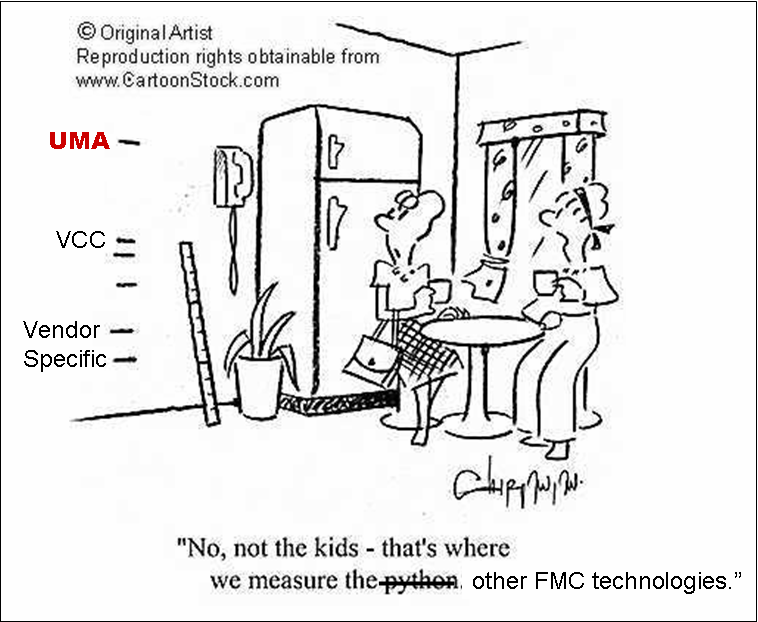
I was on a call the other day with a very large service provider involved in UMA. Unpromted, the technical manager on the call said: "UMA is now the bar by which we measure any other FMC technology." Excellent!

While this should be the case, it was very comforting to to hear. UMA is one of the few technologies available today. There are vendor proprietary solutions and "pre-VCC" solutions, but UMA is the first standardized approach. And frankly, I think UMA has set the comparitive bar very high.

The user experience for UMA is exactly the same on Wi-Fi as on GSM, it supports full mobility of packet services (for SIP and IMS), it fits into the existing mobile network OSS/BSS and it is quite straight-forward to deploy

Because the specification is still being finalized, it's hard to tell what a VCC product will really do. But from what I've seen so far, UMA doens't have much to worry about.

Wednesday, November 01, 2006

UMA Keeps Delivering

Patrick Donegan from Heavy Reading has a new research report out on dual-mode cellular/Wi-Fi services titled "WirelessVOIP & the Future of Carrier Voice Services".

In an Unstrung article, Patrick makes the point that while the market is just getting started, there’s “still something left out of the total value proposition” for dual mode services.

But after reading the article, I can’t help thinking he really meant that there’s “still something left out of the total value proposition ...for non-UMA based services.”

Take a read, see if you agree. But for the “issues” listed, it seemed like UMA-based solutions were covered. The point being made was that it was really the non-UMA based solutions which were missing something. I couldn't agree more.

That darn UMA, it keeps delivering what operators and subscribers want.