Friday, September 12, 2008

RIM Flips with New UMA-enabled Pearl

Yes, the new RIM Blackberry Pearl (8220) is the first flip phone for the company, and continues their tradition of UMA and Wi-Fi.

The US market is famously fickled for flip phones. RIM is addressing the need.

For those of us who weren’t there, RIM co-CEO and friend of UMA Today Jim Balsillie had a keynote presentation at yesterday’s CTIA event in San Francisco. The good people at Crackberry.com covered it with a ‘real time blog’.

The presentation shows RIM really stepping up the push into the consumer market. While RIM has 54% of the US smartphone market, consumers now account for 34% of RIM’s customer base. There was a slide on the ‘four screens’, which oddly enough includes a reference to the fixed line home phone.


The list of consumer/entertainment features on the device is staggering:


-Email (of course)
-IM (MSN, Yahoo, Google, AIM, Lotus,…)
-Social networking (Facebook, myspace, quickr,…)
-Photo Sharing (flickr,...)
-Content relationships (MLB.com, NFL.com, …)
-Streaming audio (Slacker,...)
-Home media synch with iTunes, Windows Media
-Tivo controls and media playback


and the list goes on.

Below is a video clip from Crackberry.com introducing the Pearl. Very cool.


The phone will be exclusive to T-Mobile starting this fall. We can’t wait.


Wednesday, September 10, 2008

3G UMA "...at the heart of our convergence strategy"

Today Orange announced the expansion of its UMA-based Unik service to include support for 3G devices and network services. In addition, the company announced two new UMA-enabled 3G handsets, industry firsts, from Sony Ericsson and Samsung.

Orange continues to innovate on its UMA service. By extending Unik to include 3G, Orange is able to complement its macro 3G network with Wi-Fi indoors. Wi-Fi can offload the macro network, deliver high speed mobile data rates, and overcome 3G coverage/performance issues when the subscriber is in the home or office.

With this announcement, Orange now effectively turns all the LiveBoxes in France into unlicensed femtocells. That’s an installed base of over 4 million units.

I think the quote from Mr. Penalvar, senior executive vice president of strategy, says it best: “…UMA is at the heart of our convergence strategy.”

Tuesday, September 09, 2008

Sony Ericsson's #1

Well, a slight grammatical play here, what I meant to say is that today Sony Ericsson announced its first UMA-enabled handset, and it looks like a winner.

Today Engadget covered the new ‘powerhouse’ G705u device. It supports a UMA, along with a full complement of traditional RAN radios including quad-band 2G, and UMTS/HSUPA 850/1900/2100. That’s right, it’s also one of the first UMA/3G devices on the market today. Sony Ericsson’s first, in two categories!

In addition, the phone comes with aGPS, an RSS reader, a full HTML browser and a 3.2 mega pixel camera with direct uploads to YouTube. Very cool.

The first roll-out is Orange in Europe, but a US version is in the works.

UMA Today can now say that the top handset vendors support UMA: Nokia, Samsung, Sony Ericsson, Motorola, LG Electronics and RIM. Now about that HTC phone…

Tuesday, September 02, 2008

Wi-Fi Gets Roaming


A long awaited (at least from UMA Today’s perspective) Wi-Fi specification was finally ratified by the IEEE last week. The 802.11r specification lets Wi-Fi devices roam quickly between Wi-Fi access points within a network.

Officially known as ‘fast basic service set transition’, the concept behind 802.11r is to enable a device to establish access to and qualifications of a neighbor Wi-Fi access point before transitioning from the current AP.

For a dual-mode handset call, this capability is critical. Because UMA relies on an IPSec tunnel anchored on the handset, the phone must receive the same IP address from the new AP as it currently has from the current AP before it can roam. Without a constant IP address, the IPSec tunnel fails and the call transitions back to the macro RAN (not a tragedy, but a hassle).

The 802.11r spec has been in the works since 2005 and finally crossed the finish line. Look for it in devices and APs shortly.

Tuesday, August 26, 2008

Mind the gap

As mobile data usage explodes, mobile operators are noticing a growing gap between bytes delivered and revenue generated.

With voice traffic, each additional minute of traffic typically generates an equal amount of revenues.

Today, data revenues have jumped from per byte to flat rate and usage is exploding, generating a traffic/revenue gap.

With estimates indicating as much as 50% of mobile traffic is generated in the home, a home zone service offer, based on low-power in-home radios like femtocells or Wi-Fi, are helping mobile operators ‘mind the gap.’ With a home zone service offer, operators are able to offload bandwidth intensive media-rich applications onto the user’s own fixed- broadband network. The result is a win-win situation for operators and users. Operators collect the flat rate fee, even for traffic not carried on their network, whereas users receive high quality broadband access on their mobile phones.

Nokia Drops VoIP Support from new N Series?

As reported at GigaOm this weekend, apparently Nokia has dropped support for its VoIP applications on some new N series products going forward.

What appears to have happened is that some, but not all, of Nokia’s embedded SIP/VoIP stack has been removed. Some view this as an opportunity for more third party VoIP developers to jump in and innovate. Others view this as Nokia capitulating to the demands of mobile operators who see third-party VoIP apps cannibalizing high-margin international voice traffic.

Regardless, it re-opens the discussion about Nokia supporting a UMA client in the N and potentially E series devices. Nokia is the largest supplier of Wi-Fi-enabled devices today, and the lack of support for UMA in their N series products continues to be puzzling.

Capabilities such as ‘internet offload’, a dynamic routing capability in the handset which sends (for example) GSM voice traffic through the UMA tunnel but routes third party SIP/VoIP traffic directly to the internet, make it even easier for Nokia to support UMA and SIP/VoIP concurrently.

Wednesday, August 20, 2008

Smartphones: The new 'hot spot' for Wi-Fi?

According to a recent report from industry researcher Canalys, a whooping 58% of smartphones now ship with Wi-Fi. This underscores something we at UMAToday have believed for some time, that in this category of device, Wi-Fi is more than a feature, it’s a requirement.

As flat rate data plans proliferate, mobile operators are viewing Wi-Fi as a complementary technology. With Wi-Fi penetration in European ‘internet connected’ households at nearly 50%, mobile operators are looking to use low cost, high performance Wi-Fi to offload media-rich data traffic.

Tuesday, August 19, 2008

Psst... Want a free femtocell?

In my continuing fascination with the Sprint femtocell service Airave, I’ve been following articles and blogs about the service. From the comments on-line, it’s clear the product is a hit. By making it a ‘2G’ product, Sprint has assured compatibility with all the handsets in the field. While there are minor issues, for people with little or no coverage (a far to common occurrence in the US), this is the wireless equivalent of ‘pennies from heaven’.

The one complain seems to be the pricing. Not much of a surprise there. A one time fee of $99.00 and then $4.95 a month to get five bars of coverage in your home seems a bit steep for something one expects from their mobile provider.

But if you don’t want to pay for it, perhaps there’s another way:

In this article from the San Francisco Chronicle, Sprint representatives said that on a case-by-case basis, some customers in problem areas with bad reception might be eligible for a free or discounted Airave or waived monthly fees.

Several of the bloggers who are ‘raving about Airave’ indicate they received the unit at no charge after complaining to Sprint customer service.

I have blogged about this as a face-off between two ‘home zone’ service offers, the other being T-Mobile’s “Unlimited Mobile Calling” (aka HotSpot@Home). I viewed Sprint’s push as a competitive response to T-Mobile’s Wi-Fi-based offer.

But perhaps Sprint has a more pressing need for the femtocell. An analysis of Q2 08 operating performance for the ‘big four’ mobile operators in the US showed negative trends for Sprint in nearly every category. Especially troubling is the 4% decline in the total subscriber base.

One way to stop subscribers from leaving, especially those with coverage issues, is to give them a femtocell.

Monday, August 11, 2008

Rumor Mill: Blackberry Javelin

Engadget today offered a look at the new Blackberry Javelin, suggesting it is a replacement for the Curve. It also looks like RIM is trying to beat out Samsung for the most UMA-enabled handsets. The future looks bright.

Thursday, August 07, 2008

Blackberry 'Kickstart' Coming to Rogers


Several rumor sources today regarding a new clam-shell RIM Blackberry called the 'Kickstart'. According to Boy Genius, the Kickstart will appear at Rogers with support for their UMA service. RIM continues to be bullish on UMA.

Tuesday, July 29, 2008

Will Consumers Pay for Coverage?

If there was ever a place in the world to explore consumer’s reaction to paying for coverage, it’s the US. While coverage undoubtedly improves year after year, the ads and tag lines from AT&T (more bars in more places) and Verizon (America’s most reliable network) tell the story that coverage is an important issue for American consumers.

So it is with great interest that we watch Sprint’s Airave femtocell service launch. Engadget reported today that consumers across the US can now order the Airave service.

The upfront price of the femtocell has increased to $99.99 from $49.99 in the initial service trial (Indianapolis and Denver). In addition, consumers must pay $4.99/month for the privilege of putting a CDMA (2G) base station in their homes to improve coverage. It costs $10/month for unlimited flat rate calling.

While some might question the logic of using a 2G/CDMA radio in the Airave (slower data service indoors, anyone?), it does ensure that the service will work with 100% of its deployed base of handsets, rather than the fraction of subscribers with 3G (EV-DO) phones.

Of course, T-Mobile’s HotSpot @Home service is the incumbent ‘home zone’ service offer in the US. There is no charge for using Wi-Fi to improve coverage. Subscribers can use existing Wi-Fi access points anywhere in the world to increase signal strength indoors. Consumers need a UMA-enabled phone, typically free or less than $100 with a two year service contract.

So it looks like the game is on for US consumers and mobile service providers. It will be interesting to see how this plays out.

Thursday, July 24, 2008

Sagem makes it 3

sagemmy519xSagem's latest dual-mode handset, my519X, is now on the market and available to subscribers of Orange's unik service. The new tri-band phone music phone has an MP3 player and is 108 x 48 x 11mm, weighing only 89g.

The my519x is Sagem's third dual-mode handset to be sold by Orange for customers of its UMA-based service. The company also offers the Sagem my419x and my429x, which was added just a few months ago. .

With the addition of this new phone, Orange continues to drive its goal of offering more than 20 dual-mode handsets by the end of 2008.

Tuesday, July 22, 2008

T-Mobile's Home Phone Service

The other night I stopped by my local T-Mobile store. My buddy Jessica the sales rep was there. This time she knew to stay out of the way of the camera.

Here's some video of the visit. Jessica said there had been pretty strong demand. Well, why not, $10/month for home phone service. It's quite a deal.


Thursday, July 03, 2008

Wi-Fi Stays Strong

The EU recently finished a study of telecom in the EU27 countries. The full study is published here in PDF.

One interesting statistic is the penetration of Wi-Fi into households with internet access. Within the EU27, 46% of households with internet access have Wi-Fi. As one would expect, the number actually goes up to nearly half (48%) when looking at just the EU15.

Topping the list in terms of penetration is Spain (68%) and France (67%), with Luxembourg at the top with 75% of internet enabled households using Wi-Fi.

It’s no wonder that Berg Insight projected Wi-Fi in handsets to grow at a CAGR of 71% over the next four years. By 2012, Berg projects 400 million handsets with Wi-Fi. The primary drivers are high speed interent access in the home/office, and ‘connected home’ applications.

Wednesday, July 02, 2008

US Market Heats Up


If the rumors are true, things in the home zone market are about to get very interesting in the US.

Yesterday, there was a flurry of rumors that Sprint will launch their femtocell-based Airave service nationwide July 15th. The service has been in limited commercial trial for more than 6 months in the US.

Market watchers (like me) like to compare the service offers. According to the rumors Sprint will offer the Airave femtocell to subscribers for an upfront fee of $99 and $15/month (or $30/month for families). In return consumers get unlimited nationwide calling when attached to the femtocell, and improved coverage.

T-Mobile’s Wi-Fi based offer, HotSpot @Home, lets consumers use Wi-Fi access points already in the home or get new ‘optimized’ Wi-Fi routers from T-Mobile, which are free with a two year contract. Consumers can use Wi-Fi to improve coverage for their existing mobile plan. Or for an additional $10/month ($20/mos for families), subscribers can an add unlimited nationwide calling option when attached to Wi-Fi.

Interestingly, in a video interview from the Avren femtocell conference, Lauren Town, head of marketing at Orange for Wi-Fi-based home service Unik, noted that the value proposition articulated for femtocell home zones during the conference was nearly identical to their existing service.

It’s not clear if Sprint’s rate will come down to $10/month to match the T-Mobile offer. One clear advantage is that Sprint’s femtocell is 1xRTT (or ‘2G’ in CDMA parlance), which means that it will work with the entire installed base of Sprint handsets. T-Mobile's advantage? The service works on Wi-Fi anywhere in the world (enterprise, outside US,...) rather than just one femtocell.

Like many new offers, Sprint service has faced some growing pains during the initial trial phase. Presumably these issues have been worked out.

If anything, the pressure is increasing for AT&T and Verizon. Neither company has a ‘home zone’ offer, which means neither company has the ability to create a location specific service offer like ‘unlimited flat rate calling from home’.

PS – I just noticed this. The address used to be http://airave.sprint.com. But that address now redirects to http://www.sprintenterprise.com/airave/ Hummm…

Tuesday, July 01, 2008

An unlicensed femtocell

The market is catching on to the benefits of home zone services, where consumers get mobile services that work better and cost less. For operators, the ability to offload the macro network and increase the performance of mobile services indoors, coupled with the ability to develop location specific home or enterprise services has driven increased interest in this market opportunity.

Typically we talk about the need for home zone services, irrespective of the underlying radio technology (Wi-Fi or femtocell). For consumer and service providers, the benefits are nearly identical.

But an interesting trend has emerged in the press. Recently there have been several references to the ‘unlicensed femtocell’, perhaps known by the more common name of Wi-Fi.

The comparison makes sense. Femtocells have a couple of generic properties. One is a low power radio designed for use in-building CPE. Second is the ability for these devices to be deployed as consumer without operator intervention. Third, they are ‘self organizing’, meaning they determine their environment and adjust the capabilities accordingly. Forth, the term femtocell is actually radio agnostic. ‘Femtocell’ is applied to CDMA, UMTS, EV-DO, GSM, LTE, even WiMAX. While the one thing these have in common is that the frequencies are licensed, why not add 802.11 b/g to the list?

Now before you think this is something I made up, there have been several references of late:

This article in DigiTimes (“Tecom Ships UMA Femtocells”) refers to ‘UMA femtocells’ being shipped to T-Mobile. Clearly not the classic definition, these were in fact Wi-Fi terminal adaptors.

This article in The Register (“Femto Forum Gets Big Ideas”) comments that “In the USA T-Mobile is already deploying 2G femtocells to provide coverage in customers’ homes.” True, but it is an 802.11 b/g femtocell.

This last one is perhaps the most interesting. Ozzie Diaz, Chief Technologies for HP's wireless business, comments on his blog (“Wireless Operators Getting the Runaround”) about the importance of local radios:

One operator who does seem to have a clue on making use of these non-cellular radios in handsets is T-Mobile USA in their Hotspot@Home with unlimited calling while at home connected over their WiFi access point connected back to the T-Mobile core network. In essence a “femtocell” without the pain of the frequency planning or spectrum management. But taking the same advantage of femtocells and using the customers Internet access link at home for “free” backhaul to the core network…FABULOUS model of eliminating a BIG CAPEX problem for themselves.

It just gets you thinking about what a femtocell really is, a tool for making mobile services work better and cost less.

Thursday, June 26, 2008

A Home Zone is a Home Zone

This week ABI Research released the results of a survey conducted on behalf of Motorola. The article states that while “…the majority of consumers have never heard of femtocells…”, “…more than 40% of European mobile and internet users plan to purchase femtocells in the next 12 months.”

It’s easy to conclude then, that the questions focused not on the wireless technology to be used in the home (e.g. a ‘femtocell’), but on the benefits of having a “Home Zone” service, where the key factors were better in-home mobile coverage and lower costs.

Demand was highest in Poland, Spain and Italy, with moderate demand in France and the UK. Germany had the lowest demand of the six countries surveyed.

We at UMA Today thought this sounded a bit familiar. Through the magic of the web, we were able to recall a similar announcement from Motorola in August, 2005. Three years ago, Motorola announced the results of a survey of 1,000 consumers in six countries on the demand for a dual-mode handset service. This time the countries were France, Germany, Spain, Sweden, Italy and the UK.

And the results??? About the same.

Demand was highest in Sweden, Spain and Italy, moderate demand in France, lower demand in the UK and Germany.

I think there are some very interesting data-points from both surveys:

  • Clearly there is continued demand for home zone services, regardless of the technology.
  • I find it ironic that Italy continues to show strong demand, showing me that Telecom Italia Mobile’s Unica service was a victim of regulatory roadblocks rather than consumer interest.
  • Orange’s plans for its Unik/Unique service are in UK, Spain, and Poland, three countries with strong demand for Home Zone services.

UMA Today continues to be a strong supporter of Home Zone services, and this is simply confirms that there is market demand from consumers for a thoughtful, value-oriented service offer.

The Mobile Operator's Triple Play

Mobile operators have had a unique influence on personal communications. The rise of mobile services has put a phone into nearly everyone’s hand. Yet as a network-based service, the mobile has been largely disconnected from our most personal location: the home.

Over the past few years, mobile service providers have started to reach into the home by acquiring broadband service providers. The attraction is easy to see. Consumers buy mobile, consumers buy broadband, why not get broadband service from your mobile provider?

In addition, Universal Mobile Access technologies enable mobile providers to deliver mobile services over the broadband network through Wi-Fi and femtocell radios in the home. This ‘double-play’ service opportunity is building, with operators trialing and deploying ‘Home Zone’ services in the market today.

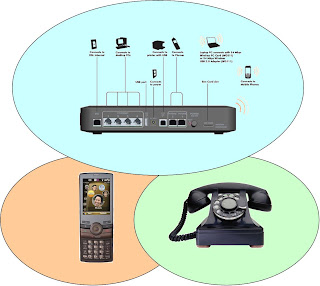
But yesterday’s announcement of T-Mobile’s fixed line home service, a VoIP offer from a mobile provider, suddenly opens up the mobile operator’s triple play: mobile, broadband and fixed.

In all fairness, mobile operators have tried to offer fixed line VoIP services in the past. But rather than using the existing mobile voice switches (MSCs), mobile operators were forced to buy new VoIP switches. Because these switches were separate from the MSCs providing the mobile voice service, there was a ‘disconnect’ to the offer.

There was a significant amount of work to integrate the bill from the VoIP switch into the bill for the mobile switch (in some cases, consumers received two bills…). With a new switch, a different provisioning system needed to be established to enable the VoIP service. Because mobile calls are anchored on the MSC and calls on the fixed network are anchored on the VoIP switch, there is no easy way to provide combinational services like dual ring and single voice mail.

With the advent of the UMA terminal adaptor, now mobile operators can seamlessly integrate fixed line home phone service directly into their existing mobile switching infrastructure, billing and provisioning systems. Calls on the fixed line appear simply as a second line within a subscriber’s existing service.

The market is already on the trajectory of a “Home Zone Triple Play”. Clearly the Linksys product, which supports a UMA terminal adaptor and Wi-Fi, is ideal for an operator to bring together dual-mode service, home phone service and broadband.

Within the femtocell community, there is a tremendous push to move into integrated femtocell products. Many companies have announced ‘integrated’ femtocell platforms to support DSL, Wi-Fi, and fixed line VoIP.

Looks like mobile operators are starting to attack the home.
Wednesday, June 25, 2008

T-Mobile's Fixed-line Home Phone Service To Go Nationwide

The now re-named “T-Mobile @Home” fixed line VoIP service looks set for a nationwide launch. I’ll be heading to my local T-Mobile store this week to check it out.

The service, which has been in limited commercial release in Dallas and Seattle, looks to be an enormous success. The article states that a whopping “…45 percent of users of the service … switched from other mobile operators”. Unbelievable!!!!!!

The offer is an incredible value, so I guess it makes sense. T-Mobile @Home offers consumers unlimited flat rate calling for $10/month from their fixed phone line. Comcast, my cable company, keeps telling me I can get the same service for $40.

Britt Wehrman, director of product development for T-Mobile, explains that many households maintain a fixed line home phone for convenience and ease of use. This service is addressing the segment of the market

The “T-Mobile @Home” service is separate from T-Mobile’s dual-mode service “HotSpot @Home”.

If you recall on June 13th there was an article in DigiTimes titled “Tecom gears up shipments of UMA femtocell base stations”. The article goes on to estimate that Tecom will ship 1 million units by the end of 2008.

Clearly there was a typo with the title, as there are no femtocell deployments with these types of volumes anywhere in the world yet. However, it looks like the Tecom product could be at the heart of the T-Mobile @Home service. If T-Mobile (45% inbound churn) and Tecom (1 m units in 2008) are correct, this is going to be a huge success.

Monday, June 23, 2008

T-Mobile Expands


Today T-Mobile added the Nokia 6301 and Samsung T339 dual-mode phones to their line-up for the HotSpot @Home service.

With 8 HS@H phones available today, T-Mobile has most of the bases covered. The much anticipated HTC Shadow II will fill in the Windows Mobile 6.1 hole and round out the portfolio for T-Mobile.

Looks like T-Mobile will make good on their goal of adding ten new handsets this year.


Friday, June 20, 2008

iCall: Opportunity or Threat

A couple weeks ago there was news about a new application for the iPhone called iCall. In the clever video demo below, the founders describe iCall as an application for the iPhone which enables users to make calls for free over any Wi-Fi access point. The video how theiCall application works:

  1. User starts call on GSM
  2. User goes into Wi-Fi
  3. Phone detected/attaches to Wi-Fi
  4. iCall application asks the user if they would like to switch the call to Wi-Fi
  5. Phone switches networks

If it sounds a lot like a UMA-based dual-mode handset service, it is. The only difference between iCall and T-Mobile’s HotSpot @Home service is step 4: User intervention.


So, is this an opportunity or a threat for the mobile operator? (Ed note: UMA Today’s position is always from the viewpoint of the mobile operator, UMA is for mobile operators)

There is a threshold for subscribers between ‘actions’ and ‘cost’. At what point does a user change their actions to save on costs? (Ed note: Here in San Jose, it’s when gas hits $4.60/gallon...)

Will users actually stop a call, press a button, and switch it to Wi-Fi to save money?

Or would users rather have a call that automatically switches to Wi-Fi and saves money? If so, then T-Mobile, Rogers, Orange, Cincinnati Bell, Telia and others already have this covered.

Thursday, June 19, 2008

The Connected Home Heats Up

Just in time for summer, there is a lot of activity in making the handset part of the Connected Home.

For those who don’t know, there is a vision of a connected home where devices develop an ad-hoc network and can communicate. Standardizing this has been the domain of UPnP and more recently DLNA.

While there are a growing number of devices (TVs, DVRs, Printers, …) which support Connected Home, the mobile phone has been consistently out of the picture. Now two different approaches are helping to pull the phone into the connection.

First is Nokia with the N95, using Wi-Fi as the transport to communication with other devices in the home.


But clearly there is only a small number of Wi-Fi enabled handsets, and so femtocell vendor ip.Access has put together his clever demonstration on how a 3G phone could be proxied into the connected home through a femtocell.


While there are some questions about how this works, it's a powerful vision of bringing mobile phones into the connected home.

Wednesday, June 18, 2008

The Rush to Support Iu-h

There has been a lot of fervor surrounding the 3GPP's activities to develop a new Home Node B (aka femtocell) standard.

I came across the blog post the other day with the clever title "Supporting Iu-h, why the rush?"

The author has a pretty good take on the situation.

Tuesday, June 17, 2008

RAN Gateway wins again

I have spent some time considering the pros and cons of the new 3GPP HNB femtocell architecture. It’s too early to call it a standard, but for now, the basic building blocks are in place for putting the spec together.

One of the fundamental building blocks of the HNB effort is a ‘RAN Gateway’ style architecture. In this case, the RAN gateway network element sits ‘parallel’ to an RNC or BSC, and connects into the mobile core network via existing, well defined circuit interfaces (Iu-CS) and packet interfaces (Iu-PS).

Operators evaluating femtocells and femto architectures immediately grasped the benefits of using a RAN gateway approach:

  • All existing circuit and packet services are supported through the femtocell access network as they are supported through the macro RAN network. This is because the RAN gateway uses the same service interfaces as the RNC.
  • A ‘RAN’ gateway is located in the RAN, with a clear demark point into the mobile core network. For operators, they did not need to change the MSC or the service core in any dramatic fashion.

For all the rhetoric and posturing around the benefits of SIP and IMS, operators quickly understood that the most pragmatic approach for femtocell service delivery was through a RAN gateway architecture. In fact, one of the things that the proposals from Huawei, NSN, Alcatel/Lucent and Kineto/NEC/Motorola (ie UMA/GAN) all had in common was a RAN gateway.

From a UMA perspective, one important outcome of the HNB specification is a validation of the RAN gateway architecture operators and vendors alike.

UMA/GAN is, of course, the original RAN gateway architecture.

I harken back to the early days of dual-mode handsets (DMH). The debate raged: IMS/SIP/VCC vs UMA/GAN. It’s taken 3 years for this to sort itself out in the market. Today, it’s clear that UMA/GAN and the RAN gateway architecture is the (only?) choice.

In the last 12 months, the debate started again, this time for femtocells. But just as quickly, a winner was declared: RAN gateway for HNB (a la GAN).

Friday, June 06, 2008

Softmobile client from Gemalto

A UMA-enabled softmobile client is an application which has been on the drawing board for some time. There has been interest, but it’s been slow in coming.

For those who don’t know, the UMA-enabled softmobile client is a mobile telephony interface application which runs on a laptop and connects to the mobile core network via UMA.

The application is ideal for operators to offer their subscribers another way to use their services, especially when traveling outside the home country. Typically when I travel to Europe, I connect my laptop at the hotel and fire up Skype. But if I were to have a softmobile client from my GSM provider T-Mobile, I could use it instead.

Back at MWC 08, technology supplier Vitendo announced they had developed a UMA-based soft mobile. In addition, Gemalto announced that Orange has selected their UpTEQ Smart Dongle. But the announcement said nothing about UMA.

Now on their web site, the UpTeq Smart Dongle lists support for UMA.

This week, Orange UK announced plans to ratchet up their services and alluded to, among other things, a “…new ‘totally connected’ product line – including laptops, to build on fixed and mobile broadband capabilities”

We’ll have to keep an eye out to see if Orange UK becomes the launch pad for the softmobile application.

Thursday, June 05, 2008

3GPP Selects Femtocell Standard, and it’s not (exactly) UMA/GAN

It was announced by multiple sources this week that 3GPP selected a reference architecture for femtocell-to-core network connectivity. This isn’t the completed standard, but sets the framework for the 3GPP RAN 3 working group to develop a full specification. The plan of record, per the 3GPP, is for the full stage 2 and stage 3 documents to be completed by Dec 2008 (in Release 8).

As has also been point out recently, the existing 3GPP UMA/GAN specification was one of a few architectures being considered as the basis for a formal 3GPP femtocell standard. The net result is that the UMA/GAN standard, as is, was not chosen. Sad but true. In order to reach an industry consensus on a HNB architecture there was a measure of compromise from all the participating companies. That’s the nature of standards: compromise.

However, while the HNB reference architecture is not full UMA/GAN, it adopts a number of key principles first introduced in the 3GPP GAN standard. For example, at the highest level, it follows an access-based (rather than core-based) approach, leveraging the existing Iu-cs/Iu-ps interfaces into the core service network. It also identifies the use of a specific protocol for solving a number of challenges associated with the ad-hoc deployment of devices over the internet.

Frankly, while the UMA community would have been delighted if 3GPP had adopted GAN lock-stock-and barrel (as they say in the US) as the formal femtocell standard, the likelihood has always been low. Fortunately, the agreed femtocell architecture builds on several core principles of GAN, which will help accelerate the market.

ThinkFemtocell has a good breakdown of different elements of the work.

For at least a little while longer, UMA/GAN remains the only 3GPP standard which supports femtocells today...

Wednesday, June 04, 2008

Rogers Launches Pearl 8120

Rogers, the latest UMA-based dual-mode service provider, today launched the RIM Pearl 8120 handset in their portfolio. The UMA Pearl is currently available from Orange and T-Mobile as well. It's good to see Rogers expanding their handset portfolio.

Monday, June 02, 2008

Vodafone Station: Screaming for UMA

As you may have seen, Vodafone announced a new product called “Station”. The original announcement was a bit confusing, but now that the dust has settled, I think it’s becoming clear.

The Station, made by Huawei, is a broadband router/modem. It can use either the integrated ADSL2+ modem or HSPA (via an additional dongle/UBS) for backhaul on the WAN. On the LAN, the Station provides Wi-Fi.

The target is to provide Vodafone subscribers with a broadband WAN connection. The target audience is likely someone using the Voda HSPA network for laptop data access. When at home, the HSPA network may have in-building propagation issues and the throughput/data rate may be low. Enter the Station. Install the Station with your HSPA dongle/USB key near a window to get a strong HSPA signal from the macro network. Then the Station uses Wi-Fi to transmit that signal to the laptop when at home.

So what is the ADSL2+ modem for? Well presumably it is faster to use the fixed network. And while I’m just speculating, I’ll bet they don’t want people sitting in their homes streaming lots of data over the HSPA network. Therefore, to offload the macro network, it’s better to have users running over a fixed line DSL connection. So users can start with HSPA while their DSL line is being installed.

The last wacky part? The Station comes with an analog voice port (ATA). Apparently when using the HSPA dongle, the station provides voice services over via the circuit voice capabilities of HSPA. And given the dongle has a SIM, this is another phone number/service available.

What I don’t understand is when the user transfers to the fixed line DSL connection, what happens to the analog voice service? With no dongle, there’s no way to associate the Station with the Vodafone mobile core. Hummm…

So why is this screaming for UMA?

First, it’s providing Wi-Fi indoors, clearly idea for a dual-mode handset service, and when the service transitions to the ADSL network, even better. With UMA, Vodafone could have a real ‘home zone’ service.

Second, the ATA ports could simply run UMA for the terminal adaptor function. Now the ports would be live/available to the consumer when connected via HSPA and/or DSL. It wouldn’t matter.

As I was writing this, I found a comment on Om Malik’s blog from someone suggesting there was a big opportunity in Wireless WAN and Wireless LAN. But can they build a femtocell (3G LAN) that uses HSPA for the WAN connection? That seems like a lot of 3G in one box, but maybe it’s on the drawing board somewhere.

Tuesday, May 27, 2008

The 3G iPhone needs "...VoIP like T-Mobile..."

Dear Steve Jobs...

In an open video/letter to Apple, the Street's senior technology correspondent Gary Krakow makes a list of his requirements for the new 3G iPhone.

Top of the list: 3G (doesn't that go without saying?)
But #2 on the list: "...a VoIP feature like T-Mobile..."

I think he means UMA!


If there's a problem, here's the link:

http://link.brightcove.com/services/link/bcpid1078966384/bclid1137812485/bctid1564516136

Wednesday, May 21, 2008

Apples and Oranges

I do appreciate the quote in Strategy Analytic’s press release about their latest research on the Enterprise FMC Market. They said “UMA is here to stay”.

But after reading the release about the report, I’m left feeling they are comparing apples and oranges.

"SIP-based services will initially be implemented by large multinationals with the capacity to carry voice traffic on their private MPLS network. Consequently, SIP-based revenues will overtake UMA revenues toward the end of the forecast period. Moreover, Microsoft's UC (Unified Communications) solution, is also likely to see positive uptake as a business solution," commented Andrew Brown, Director for Wireless Enterprise Strategies.

There’s no doubt that enterprises will use SIP for IP telephony. IP-PBXs all run SIP. One of the fundamental advantages is that the calls can be carried between PBXs over the enterprise’s own private networks. But that’s an enterprise solution.

UMA is a technology for mobile operators, not enterprises. Certainly prosumers will use UMA in the enterprise, but IT departments can’t ‘deploy UMA’. And UMA was not designed to be carried through a private network.

So comparing UMA revenues with SIP revenues for Enterprise FMC doesn’t seem to be comparing like services.

There is no doubt that UMA will have an impact on the enterprise market, but it will be an FMS impact, migrating minutes from the fixed network/PBX to the mobile network.


RIM Redux

Following up from yesterday's post, I have now listened to all of Jim Balsillie’s comments during his presentation at RIM’s Capital Markets Day, May 12, 2008, I wanted to offer up some of his quotes.

I’ve tried not to take these comments too far out of context, but basically Mr. Balsillie is bullish on UMA. About 29 minutes into the presentation (slide 24), he talks of their UMA-enabled products:


“The Wi-Fi UMA is going remarkably well.”
“I’m hard pressed to not see this as inevitable, for most if not everyone.”
“This is happening and it’s happening fast”.

In his Q&A section (slide 33), a gentleman from Integral Capital Partners asks:

“Can you comment on the carrier’s adoption, or in some cases, the lack there of, of the UMA option?”

Mr. Balsillie: “I think it’s a fair comment. I think a lot of carriers were keen on it, some were less keen on it. It’s hard to find a carrier that isn’t keen on it now. Some saw it as a threat, I saw it as an enabler, an inevitability. In a sense, it’s hard to find a carrier that isn’t excited about it now. … I think it’s just so compelling and so inevitable. It’s not going to take out the cell phone. It’s a complement.”


I couldn’t agree more.

Monday, May 19, 2008

RIM is BOLD with UMA

RIM’s presentation during their Capital Markets day (May 12, 2008) talked a bit about UMA. In the slide below, they indicate the new Bold device is part of their UMA portfolio. Sounds good to me.


Friday, May 16, 2008

Wi-Fi Battery Life: UMA Wins Again

Last month PC Magazine reviewed the RIM Blackberry 8820. The review was quite positive, but one thing which really jumped out at me was this paragraph (second to last in the article):

One area where the 8820 really excels is in endurance; it beats the Curve 8320, although the 8320's performance isn't shabby. On a cellular talk time rundown test, the 8820 lasted 11 hours and 29 minutes with the Wi-Fi and Bluetooth radios turned off. Over UMA and Wi-Fi, the phone ran for almost 14 hours on the same test. If you're tired of your cell phone's short battery life, this device should be on your short list.

Or as they state in the article:

  • Continuous talk time (cellular): 11 hours 29 minutes
  • Continuous talk time (Wi-Fi): 13 hours 55 minutes

An all too common complain about dual mode phones is that Wi-Fi = poor battery life. Yet in PC Magazine’s own test, talking over Wi-Fi/UMA resulted in a 20% improvement in talk time/performance.

The evidence continues to mount that those issues are a thing of the past. Companies that are serious about Wi-Fi in devices are optimizing the performance to meet and many times exceed the performance of GSM only.

Thursday, May 15, 2008

Sorry Sprint

A very interesting opinion was posted to the GLG site the other day. Samual Greenholtz with Telecom Pragmatics opines that Sprint’s first choice for its home zone service was a dual-mode CDMA/Wi-Fi product. But lacking a DMH standard for CDMA networks, they were forced to settle for their second choice technology: femtocells.

With that, I say “Sorry Sprint”. It’s well known that there is no UMA/GAN for CDMA networks. With a 3GPP2 version of GAN, Sprint would have been free to choose dual-mode handsets, femtocells, terminal adaptors or even softmobile clients to run off their mobile network.

Is there an opportunity here?

Another fixed line operator drops mobile

Yesterday, the Embarq CFO said that the company may drop its wireless service in 2009, handing subscribers back to its MVNO partner Sprint.

Embarq is the spin-out of Sprint’s original fixed line business. As part of the deal, Embarq developed an MVNO relationship with its former parent.

Embarq was one of the first to develop a dual-mode CDMA/Wi-Fi service. The service was announced by former FMC technology provider NewStep Networks.

In the article, Embarq said their original target was for 1 million mobile subscribers, but had achieved just over 100,000. I can only imagine what fraction of those subscribers actually chose the NewStep/FMC service. Suffice it to say, it’s hard for fixed operators to sell mobile services in general, let alone dual-mode services.

I have written in the past about the problems with fixed line operators developing dual-mode services. The problems aren’t technical. It’s possible to make a phone hand-over between fixed and mobile networks.

The problem is that dual-mode services are fundamentally about Fixed-to-Mobile Substitution (FMS). Yet that’s exactly the opposite of what a fixed operator wants. Fixed operators need MFS solutions, or a way to put mobile minutes back onto the fixed network. That is contrary to what consumers expect today.

Dual-mode services from fixed operators are always going to be challenging.

Note: I found a link to this article from another FMC company focused on fixed line operators. I think this company is actually gone now too.

Wednesday, May 14, 2008

A New Thought On Femtocell Pricing

This week, analyst Danny Briere with Telechoice wrote an interesting piece for Telephony Online. The article was titled a rather depressing “Carrier Femtocell Pricing Doomed?”

I don’t think so, and Mr. Briere offers some interesting thoughts on alternative methods of pricing femtocell services. He has two points which I’ll oversimplify here:

  • Separate the ‘coverage’ aspect of a femtocell from the ‘service’

The issue Mr. Briere has with Sprint’s Airave offer is that the consumer is required to purchase both ‘coverage’ and ‘service’ with the femtocell. A consumer wanting improved coverage must spend $50 and pay a recurring fee of $15/month. The same applies to a subscriber just interested in the flat rate calling plan. There’s no ability for Sprint to segment the subscriber benefit.

He contrasts this with T-Mobile’s Wi-Fi-based service where consumers can get ‘coverage’ by simply getting a dual-mode phone, no additional fees apply. Then if a consumer wants the flat rate calling ‘service’, they can spend an extra $10/month.

  • Don’t underestimate subscriber’s ability to pay for something they value (in this case, coverage).

I think the concept of offering the femtocell as a pure consumer product play is creative. If the consumer values coverage, they may be willing to pay to address this issue. The operator may choose to have the consumer pay full price for the femtocell, or elect to subsidize a portion of the femtocell for subscriber retention reasons. But for subscribers who are coverage challenged, this may work.

One could apply the handset subsidy approach. If you want to just by a handset, a consumer pays full price. But if you choose to sign up for a service plan and commitment, then the handset is deeply subsidized.

To be worked out is the secondary/after market usage of a femtocell. Will the consumer be able to use the femtocell with a new mobile provider? In the US, there is an immediate radio issue (GSM vs CDMA) which hampers the issue immediately.

The point is there are many ways to meet consumer need, and the femtocell market is just getting started.

Thursday, May 01, 2008

Fierce Names Top 5 'Converged' Devices

FierceWireless released their list of top ‘converged’ devices. By converged I think they meant dual-mode devices, as each of the five devices on the list had Wi-Fi.

The list was:

  1. BlackBerry 8820
  2. BlackBerry 8320
  3. HTC Mogul
  4. HTC Tilt 8925
  5. iPhone

Interestingly, two of the five are UMA-enabled. Given HTC is rumored to be bringing out UMA-enabled devices shortly, there’s a chance that next year’s list will be 4 out of 5 UMA-enabled.

As for the iPhone supporting UMA, it has been rumored in the past. But UMA in handsets is typically driven by operator requirements. Orange and Rogers both support dual-mode UMA service. Orange and Rogers also both sell the iPhone. Interesting…

PS – credit where credit is due: The image is from Gizmodo. I think choosing Mr. ROGERS to hold the iPhone is brilliant.

PPS – according to Wikipedia, the Mr. Rogers show was first developed in Toronto for CBC, making the reference doubly brilliant.